
Solution
Pharmaceutical and enzyme/protein markets
Realizing efficient separation, purification, concentration, and disinfection processes in the production of functional components and valuable substances with separation membranes
Increasing demand for enzymes and proteins along with health awareness
In addition to the advent of new pharmaceuticals, growing health awareness is drawing attention to the functions of enzymes and proteins used in various applications, thereby expanding the market for these compounds.
Although the final applications are diverse, the core manufacturing process is based on fermentation by bacteria (yeast). Numerous separation and purification processes are required to extract the target compound. As demand for enzymes and proteins grows, there is a need to streamline the related manufacturing process.
Treatment assumed for fermentation liquid
- Separation, purification, and concentration of yeast and bacteria
- Separation, purification, and concentration of enzymes
- Separation, purification, and concentration of generated compounds


What separation membranes can do
Enhancing the efficiency of treatment processes with separation membranes
-
01
Quality aspect
- Processing under non-thermal conditions without destroying microbial cells
- Achieving highly accurate separation, purification, and concentration to increase the recovery rate
-
02
Cost aspect
- Improving the recovery rate to enhance productivity and save labor
- Realizing continuous operation to improve the processing speed and even increase production
-
03
Stability
- Automates manufacturing processes to contribute to stable plant operation
Application examples in the pharmaceutical, enzyme, and protein fields
-
1
Purification of chondroitin
This ensures efficient mass production and stable quality.
- Hollow fiber
- Tubular
-
2
Concentration of amylase
Prevents denaturation due to heating to stabilize quality.
- Hollow fiber
-
3
Concentration of collagen peptides
Prevents denaturation due to heating to stabilize quality.
- Hollow fiber
-
4
Separation of microbial cells
Realizes efficient and highly accurate separation of microbial cells from culture solutions.
- Hollow fiber
Membrane materials suitable for the pharmaceutical, enzyme, and protein fields
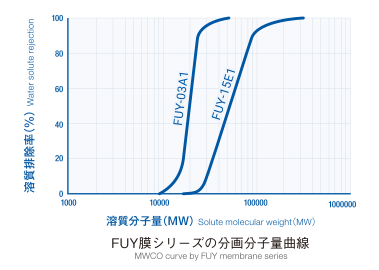
Characteristics of polyacrylonitrile (PAN)
Property of low protein adsorption Polyacrylonitrile is hydrophilic and unlikely to be subject to protein adsorption. Thus, a stable filtration rate can be obtained.
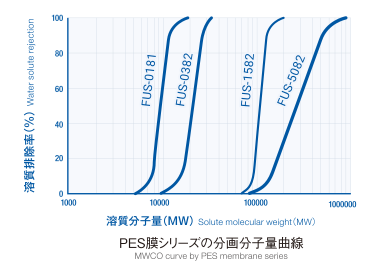
Characteristics of polyethersulfone (PES)
This material has excellent heat resistance and chemical resistance, and is useful in applications requiring membrane cleaning and disinfection. An extensive lineup of molecular weight cut-offs and hollow fiber inner diameters is available.
Treatment example
Desalination and concentration of enzymes
For concentration and purification of enzymes, polyacrylonitrile (PAN) is suitable due to its low protein adsorption and sharp separation characteristics. Since the size of an enzyme is smaller than that of a microbial cell, UF membrane treatment is suitable for and is commonly used in enzyme treatment. The UF membrane treatment used in the desalination and concentration processes can simplify these processes compared with other manufacturing methods. In addition, the effects of thermal denaturation of enzymes can be suppressed under non-thermal conditions.

- ① Culture solution is pretreated with a filter press to remove relatively large solids.
- ② Large microbial cells are separated by the UF membranes.
- ③ Water is added to the enzyme liquid. The liquid is filtered through the UF membranes to remove water and salt for desalination and purification. The continuous UF membrane treatment removes water to concentrate the enzymes.
Difference from centrifugation
Centrifugation is a method of separating substances by applying strong centrifugal force, taking advantage of the difference in weight of the substances contained.
Substances with small differences in specific gravity cannot be separated. In addition, there is a risk that microbial cells will be destroyed due to the strong centrifugal force applied. The power consumption during operation is large.
A membrane method can separate substances according to their sizes. Therefore, it can separate substances even with small differences in specific gravity. Moreover, it easily allows for continuous treatment compared with centrifugation.

Our strengths
-
01
High functionality
- Small variations in membrane pores and high membrane separation performance
- Extensive lineup of membrane pore and hollow fiber sizes. Compatible with various treatment applications
-
02
Extensive track record of success
- Since our founding, we have sold more than 500 projects in the food, pharmaceutical, and cosmetic raw materials industries, building a track record of success
- Solving customers’ problems with experience and know-how cultivated over many years
-
03
Not only membrane modules but also system design
- As a membrane manufacturer that has extensive knowledge on membrane treatment, we can offer comprehensive solutions for entire treatment systems

